In the Piedmont hills of Italy there is a sanctuary underground. It is called Damunhur and consists of several levels and rooms. In fact, there are seven large halls. They are each lavishly decorated and were constructed by hand. To see them is to be awed by the art and architecture. Above all this however, one would only see a typical Italian countryside and nothing more.
This is how I imagine the underground communities that make up the world of Pa'Chot are constructed. Beneath the surface are connected cities and other structures but above the surface little is seen except the rocky and dusty surface of the planet.
That is what the Kevutian crew of the Constantia thought they had encountered until they found the underground community living below.
Wednesday, July 22, 2015

Tuesday, July 21, 2015

Crater Lake
In my last post I pointed out a possible mountain in the midst of a depression on Pluto's moon Charron. We can come closer to home, however, to see the same phenomenon. Crater Lake in Oregon has a similar feature. Crater Lake is a caldera which is a lake formed after a volcanic eruption. If the top of the volcanic mountain is destroyed, a depression can be formed and water can fill it. In the case of Crater Lake a mountain also developed in the midst of the lake. The mountain is called Wizard Mountain.
The mountain in my book is named Mount Milnak by the people that live within and below it. They depend on that mountain to keep them protected by the rapidly changing surface of their planet and use it as a launching bay for their small ships. Unfortunately for them, the Kevutians have just discovered their mountain but do not yet know it is inhabited. Kevutians believe they are the only beings in the universe and that the universe was made for them exclusively. They are about to find out that they were very wrong in their assumption.
The mountain in my book is named Mount Milnak by the people that live within and below it. They depend on that mountain to keep them protected by the rapidly changing surface of their planet and use it as a launching bay for their small ships. Unfortunately for them, the Kevutians have just discovered their mountain but do not yet know it is inhabited. Kevutians believe they are the only beings in the universe and that the universe was made for them exclusively. They are about to find out that they were very wrong in their assumption.
Monday, July 20, 2015
Charron's Mount in a Crater
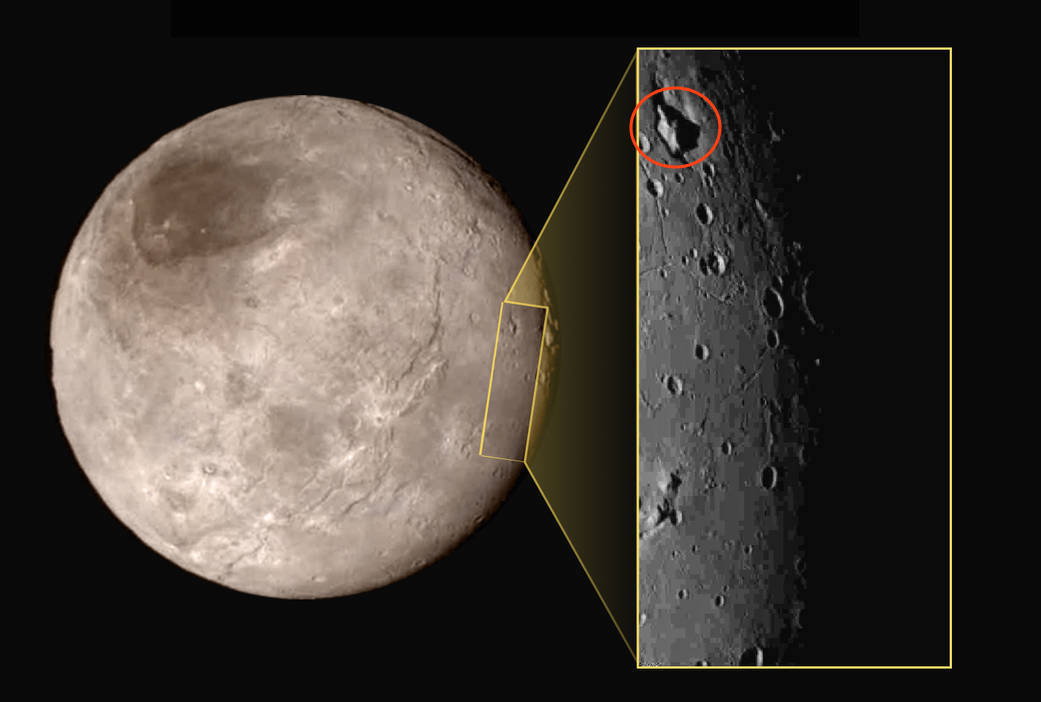
The circle in red shows a mountain peak rising from within a crater on Pluto's moon Charron.
Peak in the Valley
The planetoid Vesta reportedly has a giant crater in its southern half that is quite large compared to the others on its surface. What makes this carter even more unusual is that a mountain peak rises from within it. When I read this I decided to use the same topography for the center of the inhabitants of the planet to be called Pa'Chot. The peaceful people that live there have covered over the crater part of the structure and have used to create an underground system of small cities. Going underground prevents the need for creating an artificial atmosphere above the surface and allows for greater temperature control. That's a good thing because this particular planet has great swings of temperature differences.
Imagine my surprise when a recent photo of Pluto's moon Charron displayed a similar topography. (See next post). It seems that that a mountain amidst a crater is not so impossible.
I say that the people of Pa'Chot are mostly peaceful. They have spent many thousands of years in their mountain waiting for the return of the people they call The Ancients. Unfortunately for them, it is not The Ancients that will soon be there. The Kevutians have discovered them instead.
Imagine my surprise when a recent photo of Pluto's moon Charron displayed a similar topography. (See next post). It seems that that a mountain amidst a crater is not so impossible.
I say that the people of Pa'Chot are mostly peaceful. They have spent many thousands of years in their mountain waiting for the return of the people they call The Ancients. Unfortunately for them, it is not The Ancients that will soon be there. The Kevutians have discovered them instead.
Friday, July 17, 2015
Back To The Sea
In 1962, President John F. Kennedy said the following:
I really don't know why it is that all of us are so committed to the sea, except I think it is because in addition to the fact that the sea changes and the light changes, and ships change, it is because we all came from the sea. And it is an interesting biological fact that all of us have, in our veins the exact same percentage of salt in our blood that exists in the ocean, and, therefore, we have salt in our blood, in our sweat, in our tears. We are tied to the ocean. And when we go back to the sea, whether it is to sail or to watch it we are going back from whence we came.
He was speaking at a dinner for the sailing competition called the America's Cup. As international events go, it was not a big deal, but that one paragraph in his speech has lived on as one of his many famous lines. Why? Because in a speech directly mostly to sailors he said something that was poignant and true for all of us. We did, in fact, all come from the sea and it is part of our physical, emotional, and mental constitutions as he pointed out. It is why so many of us feel this strange connection to the sea when we visit the beach. The word sea in many languages is often spelled as a variation on "mer." It is where we get the word mermaid. It is not a coincidence in my opinion that the word "mother" (ma) in many languages is similar to the word for sea.
Shuk was a sailor for most of his life and sought to escape the banal routine of being a merchant seaman. It is why he came ashore just in time to get caught up in a revolution that he eventually led. Now, though, the ceorans have forced him to consider other options to resolving the dilemma and he is faced with a stark reality. Spreading the message of the revolution will involve taking to the sea and talking to the people of the other islands. That means, of course, that Shuk himself will have to get back onboard a sailing ship, something he hoped to avoid. It seems the sea eventually calls all of us back home.
The word 'sea' in different languages:
Spanish, Portugese, and Catalan: mar
Italian and Romanian: mare
French: mer
German: meer
Estonian and Finnish: meri
I really don't know why it is that all of us are so committed to the sea, except I think it is because in addition to the fact that the sea changes and the light changes, and ships change, it is because we all came from the sea. And it is an interesting biological fact that all of us have, in our veins the exact same percentage of salt in our blood that exists in the ocean, and, therefore, we have salt in our blood, in our sweat, in our tears. We are tied to the ocean. And when we go back to the sea, whether it is to sail or to watch it we are going back from whence we came.
He was speaking at a dinner for the sailing competition called the America's Cup. As international events go, it was not a big deal, but that one paragraph in his speech has lived on as one of his many famous lines. Why? Because in a speech directly mostly to sailors he said something that was poignant and true for all of us. We did, in fact, all come from the sea and it is part of our physical, emotional, and mental constitutions as he pointed out. It is why so many of us feel this strange connection to the sea when we visit the beach. The word sea in many languages is often spelled as a variation on "mer." It is where we get the word mermaid. It is not a coincidence in my opinion that the word "mother" (ma) in many languages is similar to the word for sea.
Shuk was a sailor for most of his life and sought to escape the banal routine of being a merchant seaman. It is why he came ashore just in time to get caught up in a revolution that he eventually led. Now, though, the ceorans have forced him to consider other options to resolving the dilemma and he is faced with a stark reality. Spreading the message of the revolution will involve taking to the sea and talking to the people of the other islands. That means, of course, that Shuk himself will have to get back onboard a sailing ship, something he hoped to avoid. It seems the sea eventually calls all of us back home.
The word 'sea' in different languages:
Spanish, Portugese, and Catalan: mar
Italian and Romanian: mare
French: mer
German: meer
Estonian and Finnish: meri
Thursday, July 16, 2015
Fire and Water
We are taught that opposites are separate entities that are distinct from each other but there is no such thing in this universe. All things are part of another. Opposites define each other but only to a certain degree. It is often the case that an extreme followed for a length of time will lead to its own opposite. The Taoists understood this concept and portrayed it through the symbol of the yin and yang.
Fire and water are apparent opposites. They help to define each other and can react against each other but not everyone has seen them as distinct. In the ancient religion of Zorastrianism, fire and water were both equally important elements of purification. Temples of worship are sometimes called fire temples and the ash of sacred fires combined with clean water are essential parts of their rituals. Fire burns away the unnecessary while water cleanses.
Shuk, the sudden and initially unwilling leader of the Kethix revolution has decided to employ both fire and water in his efforts to maintain peace at the temple. He is holding out for negotiations and a mad riot, he believes, will only work against his aims. He is sure that holding the local ceorans will be a bargaining chip with the Grand Council in Yakrutich but they are stalling and things are heating up in the northern islands. When a riot breaks out, he uses a raging fire to get the crowd's attention so that he can calm them down before violence can begin.
Fire and water are apparent opposites. They help to define each other and can react against each other but not everyone has seen them as distinct. In the ancient religion of Zorastrianism, fire and water were both equally important elements of purification. Temples of worship are sometimes called fire temples and the ash of sacred fires combined with clean water are essential parts of their rituals. Fire burns away the unnecessary while water cleanses.
Shuk, the sudden and initially unwilling leader of the Kethix revolution has decided to employ both fire and water in his efforts to maintain peace at the temple. He is holding out for negotiations and a mad riot, he believes, will only work against his aims. He is sure that holding the local ceorans will be a bargaining chip with the Grand Council in Yakrutich but they are stalling and things are heating up in the northern islands. When a riot breaks out, he uses a raging fire to get the crowd's attention so that he can calm them down before violence can begin.
Subscribe to:
Posts (Atom)